How to Choose a Hammer: Head Weight, Handle Material, and Type
The right hammer depends on the job: a claw hammer handles carpentry and nail pulling, while drilling, ball-peen, and dead-blow hammers each serve specific trades. Match head weight (in ounces or pounds) and handle material to your work volume and the surface you are striking.


Understand the Hammer Types Before You Buy
The Hammers and Striking Tools section covers far more than the classic nail driver. Claw hammers are the default for general carpentry, with a curved or straight claw for pulling nails. Ball-peen hammers are shaped for peening rivets and forming soft metal, and belong in the metalworker's kit, not the framing belt. Dead-blow hammers carry a shot-filled head that eliminates rebound on the return swing, protecting finished surfaces and assembly components. Drilling hammers deliver short, high-force blows for driving masonry anchors and striking cold chisels into concrete. Drywall hammers combine a driving face with a scoring blade for cutting board. Engineers' and masonry hammers are heavier demolition variants. Mallets, whether rubber or wood-faced, drive chisels without marring or chip striking surfaces. Sledgehammers handle breaking and demolition at the heavy end of the category. Knowing exactly which type you need prevents buying a framing-weight claw hammer for metalwork, or wasting money on a dead-blow when a standard mallet will do.
Head Weight: Match Ounces to the Task
Head weight is the single most consequential spec on any hammer, and getting it wrong costs you either accuracy or energy. For finish carpentry and trim work, 12 to 16 ounces is the accepted standard. The ESTWING E3-WC lists 14.4 ounces, which sits at the lighter end for controlled finish work. The ESTWING E3-16C and ESTWING E3-16S each specify 16 ounces, the most common all-purpose weight found in residential toolboxes. Framing carpenters driving large framing nails typically move up to 20 ounces or heavier to reduce swing count, though published weights in this section top out at 16 ounces for the standard claw category. Drilling and engineers' hammers operate at a different scale entirely: the ESTWING MRF3LB lists a 3-pound head (approximately 48 ounces), designed for the short, powerful blows needed to drive star drills and masonry chisels. Using a 16-ounce claw hammer on masonry is not just ineffective, it risks damaging the face and neck. On the lighter end, the Mr HM06NL weighs 227 grams (about 8 ounces) and is appropriate for tack and hobby tasks, not repeated structural nailing. A practical rule: select the lightest head that sinks the fastener cleanly in two to three swings. Going heavier adds fatigue without proportional speed gains for most non-framing work.
Handle Material: Steel, Fiberglass, or Plastic
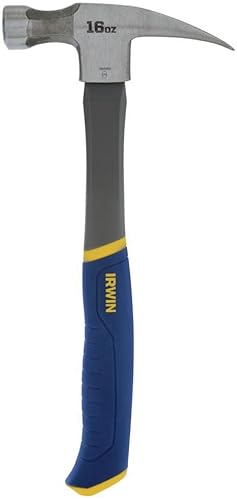
Handle material determines vibration transmission, durability, replacement cost, and weight distribution. Solid alloy steel handles, present on the ESTWING E3-WC ($30.27), ESTWING E3-16C ($34.43), ESTWING E3-16S ($24.98), and ESTWING MRF3LB ($21.98), transmit more vibration directly to the hand but have no joint between head and handle that can loosen or fail over time. Owners of these models consistently report confidence in the one-piece construction for sustained heavy use, and the review counts (11,112 for the MRF3LB, 4,459 for the E3-WC) support that track record. Fiberglass handles, as found on the IRWIN 1954889 ($11.99), absorb more vibration than solid steel and resist moisture better than wood, making fiberglass a practical middle-ground choice for regular daily use without the premium of a fully forged tool. Wood handles offer natural vibration damping and are replaceable when they break, but wood dries and cracks with neglect. The Mr HM06NL ($5.94) uses a plastic handle with a carbon steel head. Plastic handles are adequate for occasional light tasks but owner feedback on similar tools typically notes flex and fatigue under sustained professional use. If you hammer more than a few hours per week, prioritize a steel or fiberglass handle over plastic.
Head Material: Alloy Steel, Carbon Steel, and Brass
Almost all hammers sold for trade use specify either alloy steel or carbon steel heads, and the distinction matters for longevity. Alloy steel, as listed for the ESTWING line and the IRWIN 1954889, handles repeated high-impact use without deforming the striking face under normal conditions. Carbon steel heads, found on the Mr HM06NL and the Spec SPEC-M22CF ($24.97, 624 grams), are common in mid-range tools and perform well when the hammer is used within its intended weight class. The Goldblatt NOVASAT-0409-1513-34 ($21.23) calls out a mixed construction of 65Mn steel, carbon steel, TPR, and PP at a 1.4-pound head, reflecting a specialty application like drywall or tile work rather than structural framing. The Edward ET-RMH16 ($13.95) takes a distinct approach with a brass head and rubber handle. Brass is non-sparking and softer than steel, so it will not scratch or dent finished machined surfaces. This makes the ET-RMH16 appropriate for assembly and fitting work where an alloy steel face would damage precision parts. For general carpentry, stick with alloy steel. Reserve brass or rubber-faced mallets for finished surfaces and metalwork assembly.
Face Style: Smooth vs. Milled, and Why It Matters for Your Work
Hammer faces come in two main patterns: smooth and milled (also called waffle or checkered). A smooth face is the correct choice for finish carpentry because it leaves the wood surface unmarked when the face accidentally grazes trim or molding during the final set. A milled face grips nail heads more aggressively, reducing glancing blows during framing when speed matters more than surface appearance. The face style is not always published in product specs, but it is a critical detail. Based on specs and verified owner reviews, the ESTWING E3-WC at 14.4 ounces is positioned for finish and general carpentry, suggesting a smooth face. The heavier ESTWING MRF3LB at 3 pounds targets masonry and drilling tasks where surface finish is irrelevant. When a listing does not specify face style, check owner reviews for any mention of surface impressions left in wood. For mixed-use buyers who do both framing and trim, a smooth-face 16-ounce claw hammer is the more flexible default, since milled marks on trim are difficult to correct and smooth faces still drive nails effectively into framing.
What Price Ranges Actually Buy You
Hammers in this section span $5.94 to $34.43, and the gap in that range reflects real differences in material and construction, not just branding. Under $15, the Mr HM06NL at $5.94 (9,665 reviews, 4,000 buyers per month) and the IRWIN 1954889 at $11.99 (7,200 reviews, 3,000 buyers per month) both clear the 3.8-star demand floor and represent legitimate options for homeowners and light-duty users. The IRWIN's fiberglass handle and alloy steel head give it a clear construction advantage over the plastic-handled Mr HM06NL for users who swing regularly. In the $20 to $35 range, the ESTWING alloy steel line delivers one-piece forged construction. The MRF3LB at $21.98 has the highest review count in this section at 11,112, with 2,000 buyers per month, reflecting broad sustained adoption by working users. The ESTWING E3-16S at $24.98 and E3-WC at $30.27 follow with strong ratings at 4.8 and 4.9 respectively. The Spec SPEC-M22CF at $24.97 and Goldblatt at $21.23 offer mixed-material construction in the same price band. Professionals who drive nails daily should invest in the ESTWING tier for longevity. Casual homeowners who need a reliable general-purpose hammer will find the IRWIN 1954889 provides solid value without the premium.
Common mistakes to avoid
- Using a claw hammer for masonry or demolition, which requires a drilling or engineer's hammer with a heavier head like the ESTWING MRF3LB at 3 pounds
- Choosing head weight based on what feels powerful in the store rather than matching ounces to fastener size and swing frequency
- Ignoring handle vibration when buying for all-day use; alloy steel handles transmit more shock to the hand and wrist than fiberglass
- Purchasing a milled-face framing hammer for finish carpentry, where the checkered pattern leaves impressions in trim and molding
- Buying based on lowest price without checking head material; plastic-handled hammers at under $6 are not suited for sustained professional striking
- Using a claw hammer as a pry bar for heavy leverage tasks, which bends the neck over time; use a dedicated pry bar from the Pry Bars category instead
Frequently asked questions
What weight claw hammer is best for general home use?
16 ounces is the most versatile weight for homeowners handling a range of tasks from hanging pictures to light framing. Both the ESTWING E3-16C ($34.43) and ESTWING E3-16S ($24.98) are built around this standard and carry 4.8 to 4.9 star ratings based on verified owner reviews.
Is a one-piece alloy steel hammer worth the extra cost over fiberglass?
For users who drive nails regularly, yes. One-piece alloy steel handles like those on the ESTWING line never loosen, crack, or require replacement. The IRWIN 1954889 at $11.99 with a fiberglass handle is a sound alternative for occasional use, but the ESTWING MRF3LB at $21.98 has 11,112 reviews supporting its durability in sustained conditions.
Can I use a standard claw hammer on concrete or masonry?
No. Masonry work calls for a drilling hammer with a heavier, purpose-built head. The ESTWING MRF3LB at 3 pounds and $21.98 is designed for exactly that task. Striking masonry with a claw hammer risks damaging the face and stressing the handle joint.
What is the advantage of a brass-head hammer over alloy steel?
Brass is non-sparking and softer than steel, so it will not scratch or dent finished metal or precision surfaces during assembly. The Edward ET-RMH16 ($13.95, brass head, rubber handle, 16 ounces) is built for fitting and assembly work where an alloy steel face would cause surface damage.
How do I tell from a listing whether a hammer has a smooth or milled face?
Look for the terms 'smooth face' or 'finishing hammer' for finish carpentry models, and 'milled face,' 'checkered face,' or 'waffle face' for framing models. If the listing does not specify, read owner reviews for mentions of surface impressions left in wood. When in doubt, smooth face is the safer default for mixed use.
Is the Mr HM06NL a good hammer for a beginner?
It is a reasonable starting point for very light and occasional tasks. At $5.94 with 9,665 reviews and a 4.8 rating, the carbon steel head passes the demand floor and owners rate it highly for the price. The plastic handle limits its usefulness for repeated heavy striking. A beginner who plans to use a hammer regularly would be better served by the IRWIN 1954889 at $11.99 with a fiberglass handle and alloy steel head.