How to Choose a Utility Knife
Match the blade mechanism to how you work: retractable blades suit tasks where the knife moves in and out of a pocket constantly, while fixed utility blades handle prolonged heavy cutting with less fatigue. Budget under $15 covers most DIY needs; $20 to $30 buys a more durable grip and a smoother blade-change system.

Retractable vs. Fixed Blade: The Core Decision
Most utility knives use a sliding retractable mechanism: advance a thumb slider to expose the blade for cutting, then push it back to protect the edge while carrying. This design is ideal for box opening, drywall scoring, flooring trimming, and any task where the knife moves in and out of a tool bag or apron pocket dozens of times a day. The blade retracts fully inside the body so there is no exposed edge during carry, which matters on busy job sites and reduces snag hazards in a tool bag. Fixed utility blades lock a replaceable blade in a permanent position and are better suited for prolonged, continuous cutting sessions such as breaking down large quantities of packaging or cutting carpet, because there is no slider to fatigue your thumb over an extended run. Neither design is universally superior. The deciding question is: how often does the knife go back into your pocket between cuts? If the answer is constantly, a retractable is the safer and more practical choice. If the knife stays in your hand for long stretches, a fixed or folding utility blade lets you focus on the cut.
Blade Types: Trapezoid, Hook, and Snap-Off
Standard utility knives accept trapezoid blades, the flat four-sided format that fits the vast majority of utility knife handles on the market. These handle drywall scoring, cardboard, rope, tape, vinyl flooring, and thin sheet material cleanly. Hook blades have a curved tip that catches under surfaces like carpet, roofing shingles, or strapping tape and cuts on the pull stroke, preventing the blade from diving into the substrate beneath the material you are cutting. Snap-off blades are segmented into scored sections: when the leading edge dulls, you break off the front segment to expose a fresh edge without replacing the whole blade, which speeds up high-volume jobs like cutting vinyl or wallpaper. When evaluating a utility knife, confirm which blade standard the body accepts before buying. Tools that use proprietary blade formats limit your replacement options and often cost more per blade. Standard trapezoid blades are available from every hardware retailer as replacement packs, which keeps ongoing costs low no matter which brand of knife you carry.
Handle Material and Grip Quality
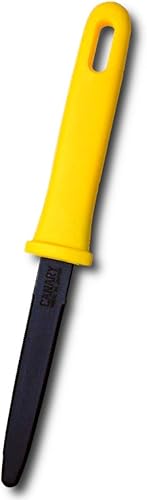
Handle material affects both durability and control under sustained use. Polypropylene and ABS plastic bodies are lightweight and resist solvents and moisture, though smooth-barrel plastic can feel insecure in wet or gloved hands. The CANARY DC-190F uses a polypropylene handle and lists an overall length of 7.48 inches, which gives good reach for box work while keeping weight down. Thermoplastic rubber (TPR) overmolding adds traction and reduces hand fatigue on longer cutting runs, and it is increasingly common even on sub-$15 utility knives. Handle thickness is also worth considering: a thin barrel is easier to control on detail cuts like scoring trim lines; a thicker full-grip handle lets you transfer more force to the blade when cutting through insulation board or heavy corrugated material. Finger grooves or defined grip contouring give your hand a consistent position and reduce the chance of the hand drifting forward onto the blade during a pull cut. For most DIY users, a plastic handle with a rubber grip zone is sufficient. Tradespeople who use the knife for hours at a stretch will appreciate a more contoured or cushioned grip at the $20 to $30 price point.
Slider Lock and Blade Depth Control
On retractable utility knives, the slider that advances the blade should click positively into each position and hold there under cutting load without drifting. Low-quality sliders creep back under pressure, which reduces cutting depth mid-stroke and creates an inconsistent edge. Three-position sliders let you set blade exposure to approximately one-third, two-thirds, or fully extended, which is useful when you want a shallow score on drywall versus full exposure for cutting through corrugated cardboard or foam board. The blade-release mechanism, which allows you to swap blades without a separate tool on better models, should require deliberate engagement rather than activating under a normal grip. Test the slider feel before committing to a knife: it should advance smoothly and lock with a noticeable resistance at each click stop rather than sliding freely. This is the single build-quality detail that separates a reliable utility knife from a frustrating one, and it is not always apparent from a price tag alone.
On-Board Blade Storage and Replacement Speed
Professional-grade utility knives store spare blades inside the handle, accessible by opening a back cap or side door. Capacity typically runs three to five blades. On-board storage eliminates time lost hunting for a blade pack when you are mid-job and the working edge dulls. Budget knives omit this feature, so you either carry a separate blade dispenser on your belt or stop work entirely to find replacements. If you regularly cut materials that dull blades quickly, such as fiberglass insulation, stucco mesh, or heavy corrugated board, on-board storage is a meaningful practical advantage rather than a luxury. The blade-change mechanism should allow a clean swap without needing a screwdriver or a second tool, and the replacement blade should seat firmly with no lateral play after installation. A loose blade causes the cut to wander and can create a safety hazard if the blade shifts under load.
Budget Tiers and Which to Choose
Under $10, the WORKPRO W013053AU at $9.99 and the CANARY DC-190F at $7.99 both carry 4.8 stars and earn strong buyer demand signals based on listing data. The WORKPRO W013053AU shows 10,000 buyers per month, making it one of the most actively purchased utility knives in this section. Both options accept standard trapezoid replacement blades, which is the single most important feature at this price tier since blade availability determines long-term running cost. Owners report reliable everyday performance on cardboard, drywall, and light trimming tasks. The Palmetto TF606WS at $24.95 has accumulated 10,200 reviews and draws 1,000 buyers per month, and typically offers a more refined slider mechanism and a more secure grip than the sub-$10 tier. For occasional home use such as seasonal project work, a $8 to $10 knife is fully sufficient provided you keep replacement blades on hand. DIYers with frequent cutting tasks and tradespeople will find the ergonomic and durability improvements in the $20 to $30 range worth the extra spend, particularly if the knife stays in hand for long periods where grip fatigue adds up across a workday.
Common mistakes to avoid
- Buying a knife without confirming the blade standard it accepts, then discovering compatible replacements are not stocked locally
- Choosing a fixed-blade utility knife for a job requiring frequent re-pocketing between cuts, leading to unsafe open-blade carry
- Ignoring slider lock quality on retractable knives and ending up with a blade that creeps back under cutting pressure mid-stroke
- Continuing to use a dull blade instead of changing it, which forces more pressure and increases the chance of the blade skipping off the cut line
- Evaluating a utility knife only by blade count in the box rather than the body construction, grip quality, and lock mechanism
- Overlooking on-board blade storage when buying for frequent use, which leads to time lost searching for replacement blades during a job
Frequently asked questions
What blades fit standard utility knives?
Most utility knives accept the trapezoid blade format, sometimes sold as SK5 or SK2 steel blades. This is the most widely available replacement type and fits the large majority of utility knife bodies on the market. Always verify the blade standard in the knife listing before buying so you know replacement packs will be easy to source.
How often should I replace the blade?
Replace the blade when the cut starts to drag or tear rather than slice cleanly, or when you notice you are pressing harder than normal to get through the material. A dull blade is both slower and less safe than a sharp one. For heavy corrugated or carpet work, that threshold can arrive after an hour or less of continuous cutting.
Is a retractable utility knife safer than a fixed-blade?
For carry and storage between cuts, yes. A fully retracted blade cannot cause an accidental cut in a tool bag or apron pocket. During the cutting stroke itself, both designs carry the same risk level. What matters most is the quality of the retractable slider lock: a slider that holds firm under load is as safe as a fixed blade, while a slider that drifts back is not.
Can I score drywall with a utility knife?
Yes. Score-and-snap is the standard drywall cutting method. A trapezoid blade scores through the face paper and into the gypsum core in one firm pass, then you snap the sheet along the line and cut the back paper. A partial blade extension setting, rather than full extension, gives better depth control and reduces the chance of accidentally cutting through to the stud cavity on thin walls.
What is the difference between a utility knife and a box cutter?
The terms are commonly used interchangeably. A utility knife typically refers to a heavier-duty tool with a sliding or fixed trapezoid blade intended for a range of materials beyond just cardboard, while a box cutter is often a lighter, thinner tool primarily designed for opening packaging. Both accept the same standard trapezoid blade dimensions, so replacement blades are interchangeable between most models.
Do I need a hook blade attachment?
Only if you regularly cut carpet, roofing materials, strapping, or shrink wrap. Hook blades cut on the pull stroke by catching under the material surface rather than pushing through it, which prevents the blade from diving into the underlayment or membrane below. For general cutting tasks including drywall, cardboard, and vinyl flooring, a standard trapezoid blade is the better all-around choice.