How to Choose a Screwdriver Set
The right screwdriver set matches the drive types you use most, fits your grip comfortably, and carries enough variety for your work without duplicating tools you already own. For most DIYers a compact multi-bit driver covers 90 percent of tasks; tradespeople often add dedicated single-tip drivers in their most-used sizes alongside it.

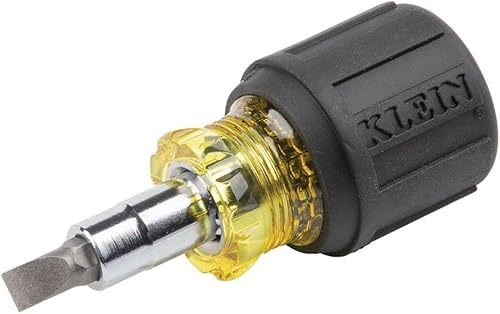

Single Driver, Multi-Bit, or Full Set?
The first decision is format. A single-purpose screwdriver is built for one drive type and one tip size, which is exactly what high-frequency tradespeople want: a tool that fits their hand the same way every time with no bit swaps. The Klein 32581 at $11.97 and 1.1 ounces shows what sustained demand looks like for this format, with 19,106 reviews and 3,000 purchases last month, making it one of the top-selling individual screwdrivers in the category. A heavier driver, such as the Klein 32288 at $40.00 and 14.7 ounces with dimensions of 8 x 3.3 x 2.1 inches, reflects a broader design intended for wider task coverage and has earned 9,216 reviews with 1,000 buyers per month. A full screwdriver set adds separate handles in different shaft lengths and sizes, which makes sense if you regularly drive long screws in deep holes and also need a stubby for tight quarters. If you have never owned screwdrivers before, start with one versatile multi-tip option and add individual pieces as you identify gaps in your actual work.
Drive Types You Need to Cover
The dominant drives in North American residential and commercial work are Phillips (cross-head) and slotted (flathead), but Robertson (square drive) appears constantly in decking and cabinetry, and Torx shows up in appliances, electronics, and automotive fasteners. A set that skips Torx will leave you stranded on a refrigerator repair or car trim panel. The Klein 32561 at $10.98 and 2.6 ounces has accumulated 14,198 reviews and sees 2,000 purchases per month, a strong signal that single-purpose dedicated drivers remain popular even where multi-bit sets are available. On the lighter end of the range, the VESSEL 900 (+)2X100 at $8.80 and 101 grams offers a precision-friendly weight for tasks where hand fatigue on small fasteners is the main concern. Before buying any set, list the fasteners in your home, vehicle, or job site. If you are only hanging drywall, two Phillips sizes and a slotted cover your day. If you repair electronics, a set reaching small Torx sizes is far more useful than one that duplicates three Phillips sizes you already own.
Handle Size, Shape, and Grip Material
Handle ergonomics directly affect both torque output and hand fatigue. A wider-diameter handle lets you apply more rotational force with less wrist effort, while a slimmer handle gives better tactile feedback on small, delicate fasteners where over-tightening is the risk. The Klein 32717 at $29.97 weighs 0.65 pounds and has drawn 3,564 reviews with 700 buyers per month, suggesting it hits a comfortable weight range for sustained use. The Klein 85191 at $34.97 weighs 8 ounces and draws 900 purchases per month, showing similar sustained demand at a slightly lighter weight. Owners across the category consistently report that a textured or bi-material grip reduces slip on oily or sweaty hands far better than smooth plastic handles. If you are choosing a set for extended screwing sessions, pay attention to the handle cross-section published in dimensions: a grip that is too narrow concentrates pressure on the palm, and one that is too wide makes precision work in tight spaces tiring.
Shaft Length and Blade Reach
Shaft length matters more than most buyers realize before their first frustrating job. A longer shaft reaches deep recessed screws and fasteners inside appliances or panel boxes, but it is unwieldy in tight spaces. The Klein 32527 at $16.64 lists a 5-inch dimension and weighs 7.04 ounces, a mid-reach profile suited to general tasks. It carries a 4.8-star rating across 4,467 reviews, though only 200 buyers per month purchase it, suggesting it serves a specific use case rather than general everyday need. The Klein 6034 at $9.94 measures 8.25 x 1 x 1 inches and weighs just 4 ounces, a slender and light profile suited for precision or confined-space work, with 600 buyers per month and 2,800 reviews confirming steady real-world use. A stubby or right-angle driver is worth adding if you regularly work inside junction boxes, behind appliances, or in cabinet interiors where a standard shaft will not fit regardless of tip type. Many multi-bit options address common shaft lengths, but a short stubby is a low-cost addition that earns its spot quickly.
What the Piece Count Actually Means
Piece count is a marketing metric, not a quality indicator. A 42-piece set sounds thorough until you realize it includes twelve bit sizes you will never use and only one Phillips #2, the drive you reach for every single day. A more honest framing is coverage per drive family: you need at minimum Phillips #1 and #2, two slotted sizes, Robertson #2, and the Torx sizes most common to your work (T10, T15, T20, and T25 cover most home and light automotive use together). The iFixit EU145475-1 at $16.96 and 159.5 grams draws 500 purchases per month at 4.8 stars, aimed at electronics repair where many specialty bit types genuinely matter rather than raw piece count for its own sake. When comparing sets, inventory the bit list against your actual fastener types. If a 10-piece set covers every drive you encounter and a 30-piece set covers the same drives plus 20 you will never see, the 10-piece is the smarter buy. Duplicate bit sizes add bulk without adding capability.
Budget, Brand, and When to Spend More
The screwdriver market has a clear value structure. Entry-level options under $15, such as the JOREST at $8.99 with 11,300 reviews and 900 buyers per month, deliver solid value for occasional light use. Mid-range tools from $15 to $45 from established brands dominate verified buyer demand: the Klein 32581 at $11.97, the Klein 32288 at $40.00, and the Klein 85191 at $34.97 each show thousands of reviews and consistent monthly purchase volumes that suggest genuine durability, not just initial enthusiasm. Spending more is justified in two specific situations. First, voltage-rated insulated drivers for live electrical work, where an unrated plastic handle offers no protection and a 1000V-rated driver is a professional safety requirement. Second, precision drivers for electronics or optics repair, where tip hardness and exact fit to the fastener recess determine whether you finish the job cleanly or strip a fastener on a component that cannot be replaced easily. For general household and construction work, the $10 to $40 range covers the ground thoroughly without overspending.
Common mistakes to avoid
- Selecting a set by piece count instead of checking whether it actually covers the drive types and tip sizes used in your real work.
- Using a tip that is too small for the fastener recess, which cams out under torque and rounds the head, turning a simple job into a damaged fastener extraction.
- Ignoring handle diameter: a grip that is too narrow concentrates palm pressure and causes fatigue during long driving sessions.
- Buying only a multi-bit set and skipping dedicated single-tip drivers for the one or two drives you use daily, where bit swapping slows you down on every task.
- Overlooking shaft length entirely: a standard 6-inch shaft will not reach deep recessed fasteners and will not fit inside tight panel boxes without a stubby or right-angle driver.
- Assuming any screwdriver is safe near electrical circuits: only drivers explicitly rated and labeled for 1000V insulation are appropriate for work near live conductors.
Frequently asked questions
How many screwdrivers do most people actually need?
For a typical homeowner, a Phillips #1, Phillips #2, medium slotted, and a small slotted driver cover the vast majority of tasks. Adding a Robertson #2 and a few Torx sizes (T15, T20, T25) handles the rest. A single versatile driver like the Klein 32288 at $40.00 and 14.7 ounces often satisfies all of these needs in one tool, with 9,216 reviews and 1,000 buyers per month confirming broad real-world use.
What is the difference between a multi-bit driver and a screwdriver set?
A multi-bit driver is one handle with interchangeable tips, letting you swap drive types without carrying extra tools. A screwdriver set gives you separate handles and shafts in different sizes. Multi-bit drivers win on portability and light-to-medium use; a full set is better if you drive large volumes of fasteners and want a dedicated, perfectly balanced handle for each job without bit swapping.
Are cheap screwdrivers worth buying or should I go straight to a name brand?
Budget options like the JOREST at $8.99 perform adequately for occasional light use, and its 11,300 reviews and 900 purchases per month indicate it holds up for a wide range of buyers. For daily or trade use, the sustained demand behind Klein models in the $10 to $40 range points to better tip fit and longer service life. Tip quality is the key variable: a tip that wears quickly costs more in stripped fasteners than you saved on the driver.
What does a 1000V insulated screwdriver mean and do I need one?
A 1000V-rated screwdriver has a handle built to resist electrical current up to 1,000 volts, providing a protective barrier if the tool contacts a live conductor. Standard screwdrivers carry no such rating and offer no meaningful protection. If you work with power off at the breaker and are a homeowner doing general repairs, a standard driver is appropriate. If you are an electrician or work regularly near live panels, an insulated driver is a professional safety requirement.
How do I know if a screwdriver tip is the right size for a fastener?
The tip should fill the entire recess with no slop or wobble. On a Phillips head, all four contact lobes should engage snugly. If the tip rocks or only touches at the center, it is too small or the wrong type and will cam out under torque, rounding the recess. For slotted fasteners, the blade width should match the slot and the blade thickness should fill the slot depth without splaying it.
Is a magnetic tip worth it on a screwdriver?
For most work, yes. A magnetized tip holds screws on the driver during placement, which matters most when working overhead, in confined spaces, or when your other hand is occupied holding a component. Owners consistently flag this as one of the most practical features for reducing dropped fasteners and retrieval time. The only exception is work immediately adjacent to sensitive magnetic media or precision electronic components where stray magnetism could cause problems.