Center Punches and Pin Punches Explained
A center punch creates a small starting dimple that guides a drill bit at the exact location you want the hole. A pin punch drives roll pins, taper pins, and pivot pins out of bores in mechanical assemblies. The two tools look similar but serve completely different purposes and are not interchangeable.

What a Center Punch Does and How It Works
A center punch is a short, tapered rod made from hardened alloy or high-carbon steel with a sharply ground tip, typically at a 60 to 90 degree included angle. You position the tip at your scribed layout intersection, hold the body vertical, and deliver a single firm hammer blow. The result is a shallow conical dimple that seats the point of a twist drill bit so it cannot skate across the surface at startup. Without that dimple, a standard drill bit on smooth metal will wander for the first fraction of an inch, pulling the hole off-location and sometimes snapping the bit. A single, well-placed blow is all that is needed. Striking the punch a second time after repositioning produces a double-dimple that shifts the entry axis and defeats the whole purpose. The Starrett 117C is a good example of a purpose-built metalworking center punch: the listed specs show a 4-inch length and 1/8-inch diameter in an all-metal body weighing 1.06 ounces, priced at $16.02 with a 4.8 rating across 4,500 verified owner reviews. That narrow diameter and light weight make it easy to hold precisely while leaving the strike zone clear for a small hammer or mallet.
What a Pin Punch Does and How It Differs
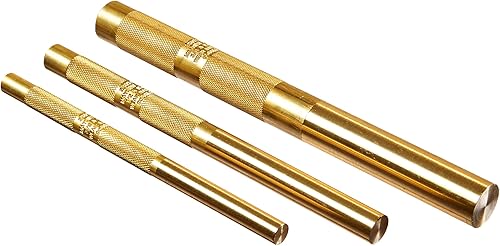
A pin punch has a straight, parallel shank that runs the full usable length and terminates in a flat face rather than a point. Its only job is to push a pin completely through a bore once the pin has been broken loose. Automotive technicians use pin punches to remove steering pivot pins and suspension clevis pins. Gunsmiths use them daily to drift out trigger group pins, hammer pins, and gas tube pins. The straight body is critical: it slides cleanly through the bore from the first contact to the final exit, never wedging. By contrast, a tapered center punch tip jams against the bore walls once the widening body enters the hole, potentially galling the bore or damaging the surrounding housing. The Mayhew 61360 is a 3-piece set in brushed brass, priced at $34.19 with a 4.8 rating and 3,100 reviews. Brass is softer than the steel bores it works in, which means the punch tip deforms slightly before it can scratch the bore wall. That is the correct choice for precision mechanisms where a hardened steel punch would leave score marks.
Telling Them Apart at a Glance
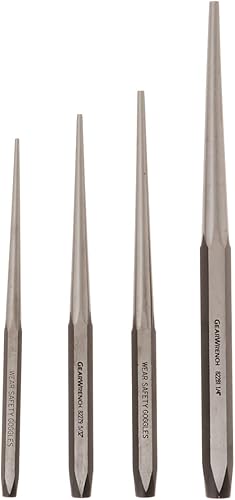
In a crowded tool drawer the two types look deceptively similar, but the tip geometry is the giveaway. Tip comes to a visible point on a center punch; the pin punch face is flat and parallel to the shank shoulder. A second clue is the shank profile: center punches widen from tip to shoulder in a continuous taper, while pin punches maintain a consistent diameter from shoulder to tip. Length is another differentiator. A center punch at 4 to 5 inches sits in the hand comfortably for precise placement. Pin punches often run longer so the tip can reach deep through a housing without the hammer striking the part. The GEARWRENCH 82307 punch set, weighing 1.72 pounds and measuring 12 x 4 x 1 inches in the set format, covers the range of straight-body driver and pin punches that a mechanic needs across common pin diameters. At $37.38 and a 4.8 rating from 651 owner reviews, it represents the multi-size approach that professionals favor over buying single punches one at a time.
Material and Finish: What to Look For
Most center punches are forged or machined from high-carbon steel or alloy steel, then selectively hardened at the tip and tempered along the body. A tip that is too hard all the way through will chip under a sharp blow; a body that is too soft will mushroom at the strike end and eventually crack. Quality alloy steel punches resist both failure modes. For pin punches, material choice depends on the application. Steel pin punches work fine for general automotive and construction work where bore finish is not a concern. Brass pin punches are mandatory for firearms, precision gearboxes, and watch mechanisms because brass is softer than the surrounding bore material and will not score or gall the walls. Bronze and nylon-tipped options exist for even more delicate applications. Finish also matters: a black oxide or polished finish on the shank reduces friction as the punch slides through a bore, and it resists corrosion during storage. Brushed brass, as seen on the Mayhew 61360 set, adds a level of corrosion resistance appropriate for a precision hand tool that is handled frequently.
Sizing Pin Punches Correctly
Sizing is the most critical specification for pin punches and is frequently misunderstood. The punch diameter should be as close as possible to the pin diameter without exceeding it. A punch that is too small will not drive the pin evenly and tends to skip off the pin head under impact, rounding the top of the pin and making it even harder to remove. A punch that is even slightly oversized will contact the bore wall instead of the pin head, scoring the bore and potentially seizing the assembly further. In practice, manufacturers sell pin punch sets in graduated sizes to cover common pin diameters from very small fractional sizes up to 3/8 inch or larger. For center punches, diameter matters much less because only the very tip contacts the work. A heavier body, like the full-metal alloy steel builds common in this category, simply absorbs hammer energy more comfortably and improves grip control. The Starrett 117C at 1/8-inch diameter suits most center-punch layout work on medium stock. Operators working on very thin sheet metal sometimes prefer an automatic spring-loaded center punch that delivers a repeatable, controlled strike without a hammer, reducing the chance of denting thin gauge material.
Proper Technique for Each Tool
For a center punch, the setup before the strike matters as much as the blow itself. Scribe your layout lines clearly, then position the punch tip at the exact intersection. Hold the body vertical, not angled toward you, and take a moment to confirm alignment before raising the hammer. Strike once, firmly. Lift the punch and check the dimple location before drilling. If the dimple is slightly off, you can correct it by repositioning the punch at the edge of the existing dimple and tapping it toward the correct position, a technique that requires a light touch. For pin punches, start with a tapered starter punch, sometimes called a drift punch or roll pin punch, to break the pin loose from its corrosion or interference fit. Once the pin moves freely, switch to a straight pin punch sized to the pin diameter and drive the pin fully out. Support the assembly so the pin exits into open air rather than jamming against a bench surface. Apply penetrating oil and let it soak for several minutes before striking if the pin is seized. Short, controlled blows are safer than single heavy strikes that can bend a slender pin punch or peen the pin head into the bore.
Sets vs. Individual Punches: Which Makes Sense
For most DIYers and general workshop users, a set that includes a center punch and a graduated range of pin punch sizes is the most practical and cost-effective starting point. Sets like the GEARWRENCH 82307, which spans the common driver punch sizes at a combined set weight of 1.72 pounds, provide the sizes needed for typical automotive, HVAC, and appliance repair work without the guesswork of buying individual punches. Professionals, particularly gunsmiths and machinists, often supplement a general set with individual punches in specific fractional sizes that come up frequently in their work, or to replace a single worn or chipped punch without discarding the rest of a set. Brass punch sets like the Mayhew 61360 3-piece set at $34.19 serve a specialized role and are purchased in addition to a standard steel set, not instead of one. When buying a set, check that each punch is labeled or color-coded by diameter, as grabbing the wrong size in the middle of a job costs time and can damage the workpiece.
Common mistakes to avoid
- Using a center punch as a pin punch: the tapered tip jams against the bore walls once the body enters, damaging the bore and potentially seizing the pin further into the assembly.
- Drilling on smooth metal without a center punch dimple first, which lets the drill bit wander at startup and places the hole off-location.
- Choosing a pin punch that is too small in diameter: a loose-fitting punch skips off the pin head under each blow, rounding the top and making removal harder.
- Striking the center punch at an angle: even a few degrees of tilt shifts the dimple off-center and deflects the drill bit at entry.
- Skipping a starter or drift punch when driving a stuck pin and going straight to a straight pin punch: the seated interference fit resists the first blow, and forcing it bends slender pin punches rather than moving the pin.
- Using a hardened steel pin punch in a firearm or precision instrument where a brass or bronze punch is required, scoring the bore and leaving metal transfer that can cause binding.
Frequently asked questions
Can I use a center punch to drive a roll pin out?
No. A center punch has a tapered body that widens from the tip upward. Once the tip enters the bore, the taper wedges against the bore walls instead of pushing the pin through. Use a straight-body pin punch whose diameter matches the pin closely. Start with a tapered starter punch to break the pin loose, then finish with the correct pin punch.
What angle should the tip of a center punch be ground to?
Most general-purpose center punches come from the factory with a tip ground to 60 to 90 degrees included angle. A 60-degree angle produces a smaller, more precise dimple and is preferred for layout work before drilling. A 90-degree angle creates a wider dimple that is easier to reseat a drill bit into but is slightly less precise. The angle is rarely published in product listings, so this spec is worth confirming with the manufacturer if precision layout is critical to your application.
Do I need a brass pin punch set, or will steel pin punches work for most jobs?
Steel pin punches are fine for most automotive, construction, and general mechanical work where bore finish is not a concern. Brass or bronze pin punches are necessary when working inside firearms, precision gearboxes, or any assembly where the bore walls must not be scratched or marked. The Mayhew 61360 is a 3-piece brass set at $34.19 designed specifically for these finish-sensitive applications. Most professionals keep both a steel set and a small brass set and select the correct material for each job.
How do I pick the right pin punch diameter?
Match the punch diameter as closely as possible to the pin diameter without going over. The punch should slide freely into the bore and contact the pin head squarely. If you do not know the pin diameter, measure with calipers before selecting a punch. A punch that is too small glances off the pin head and rounds it; a punch that is too large contacts the bore wall instead of the pin and can score or gall the bore.
My drill still wanders even after I used a center punch. What is wrong?
The most common causes are a dimple that is too shallow, a drill bit with a worn or off-center tip, or starting the drill at too high a speed. Deepen the dimple with a second, firmer blow and verify it is centered at your layout intersection. Start the drill at low speed with light pressure until the cutting edge seats fully in the dimple, then increase speed. A fresh, properly sharpened bit also helps considerably.
What is the difference between a pin punch and a drift punch?
A drift punch, also called a starter punch, has a slight taper from the shoulder to the tip and is used to start a pin moving from its interference fit. Once the pin is loose and partway out of the bore, you switch to a straight-body pin punch that follows the pin cleanly the rest of the way. Using a drift punch all the way through risks jamming the tapered body against the bore walls before the pin fully exits.